Claude Code · Antigravity · Codex · Bash · Python
Agent Field Manual
How I run Claude, Gemini swarms, and Codex as one multi-engine operating system: isolated builds, native swarms, worktree isolation, gates, handoff formats, and runnable skills, exported from my private setup and audited before publishing.
- repo nathanmauro/agent-field-manual@77ae971
- last push
- language Shell · 0 stars
- read the field manual, rendered from this repo
How I run Claude, Gemini swarms, and Codex as one multi-engine operating system.
The workflows, gates, and handoff formats I use every day, exported from my private control plane and sanitized into a copyable kit.
Current stack · Pick a workflow · See one run · See the system · Copy the agent guide


A good model can write code. A good operating system gets the code shipped.
Coding agents rarely fail because they cannot produce a plausible diff. They fail because the work around the model is improvised: context is scattered, mutation boundaries are fuzzy, verification is optional, and the next session has to reconstruct everything from scratch.
This repo is the control layer I run around three agent clients. It is process, not product: the systems these patterns write to live in their own repos, starting with Black Box, the shared memory every agent records decisions and handoffs into. It was built with the workflows it documents. Claude Code builds and verifies, Antigravity swarms fan out, Codex cross-checks when asked; I scope, review, and own every commit.
Current stack (as of November 2026)
- Two primaries, one standby, one policy. The engine split is set from local session data, not preference; the current 2+1 split dates from 2026-11-21, after 14 days of counts. Anthropic is the primary builder and orchestrator: Claude Code (Opus 5.5 at
mediumeffort by default,highwhen needed; Sonnet 5.5 / Haiku 5.5 for mechanical lookups and edits) conducts sessions and runs delegated builds. Gemini is primary for fan-out: Gemini 4 Neon in Antigravity runs native swarms (board-coordinated workers) for cross-repo ops, browser work, and Google Workspace and cloud operations. Codex is an opt-in cross-vendor verifier: since 2026-11-16 it runs only when I name it (gpt-6.1-sol for delegated builds), and it keeps the outside seat on the council. One shared operating policy governs every client: Claude Code imports it, Codex and Antigravity carry it as a hash-marked rendered block, and a multi-ring drift check fails when policy hashes, skill symlinks, hooks, docs, or decision records fall out of sync. See One policy, three clients. - A stateless specialist oracle. Fable 5.2 (and Mythos 5.2) are queried as stateless, zero-tool First-Principles Oracles (
physics,strategy,architecture,redteam) rather than interactive session drivers: stripping tool/MCP schemas and compliance boilerplate cuts quota burn by ~80% and stops hedging on unmeasured parameters. The oracle is also the outside reader for high-stakes diffs now that the default build stays inside one vendor. - Isolated builds by default, swarms for breadth. A delegated build runs as an isolated workflow: a fresh-context implementer, separate reviewers that never saw its reasoning, a fix pass for real issues only, and a main loop that owns git. Wide, shallow work goes to a swarm instead, and a swarm worker that hits deep single-repo engineering hands it back to Claude Code. Either way, workers that edit never share a checkout: each gets a worktree under a dedicated shadow tree, or they run serially. Codex is still reachable over a supervised channel when cross-vendor review is worth it.
- Where state lives. Interactive sessions run as spaces and tabs in Herdr (
herdr-appfor window placement,hcfor terminal lifecycle and inspection) with Remote Control on, one space per checkout, Claude and Antigravity sessions as tabs. Linear holds execution. Obsidian holds durable notes and parked ideas. Black Box holds decisions, handoffs, and projections across clients over MCP, and anything started but unfinished gets an open-work broadcast with a follow-up time that a periodic sweep collects. - Cost, startup hygiene, and retirement. Interactive drivers default to
mediumeffort. Unused global MCP servers and zero-use skills are pruned on a regular audit cadence, and autonomous background queues carry explicit ready-backlog caps so agent output never outruns human review. Three tools are on a retirement review for 2026-11-30, two weeks after Codex went opt-in: the Codex fleet, the shell-supervised worker bus, and a session-spray launcher. The council’s cross-vendor seat stays. - A context budget, measured. Every tool result an agent reads stays in context, so tool output is counted per call across every transcript before anything gets rebuilt. On 18,873 transcripts MCP was 3.6% of tool-result tokens (Bash 48%, Read 35%), so connector reads moved to small owned CLIs that return 12 to 21 times less for the same request, a hook trims the oversized results of the connectors that stay, and sessions rotate at a clean break instead of autocompacting. See Context budget.
Last reviewed 2026-11-23.
What it demonstrates
- Isolated delegation. A fresh-context implementer, separate-context reviewers, a fix pass for real issues only, and a main loop that owns git, inside one model family, with a stateless oracle as the outside reader on demand. Skill · template
- Native swarms with one isolation rule. Board-coordinated fan-out for cross-repo ops, browser, and workspace work, a hand-back rule for deep single-repo builds, and editing workers that never share a checkout. Concept
- Supervised delegation. A worker channel with send/watch separation, a result envelope, bounded attention, and a sandbox that keeps
.gitread-only so the human stays sole author. Concept · public adapter · skill - Stateless specialist isolation. Separating multi-turn tool orchestration from zero-tool first-principles reasoning (
exploremode and stateless oracle calls), so deep derivations and adversarial red-teams do not re-bill 100k+ tokens of tool schemas per command. Concept - Consent that survives handoffs. The human’s exact words, their source, the destination, the payload, and the limits travel with every delegated task to the final reviewed tool call. Concept
- Policy as code. One policy source, one skill source, imported by Claude Code and rendered into Codex and Antigravity as hash-marked blocks, backed by a multi-ring drift audit across policy, skill links, hooks, docs, and continuity records. Concept · template · skill registry
- Fail-closed release gates and queue backpressure. A fleet that merges its own green PRs only through a helper that re-checks mode, round, repo identity, PR head, and danger hints before and after CI, plus backlog caps that pause unattended generation when unreviewed output piles up. Skill · workflow
- Continuity that compounds without write-only bloat. Compact handoffs written when state would be lost by
git logalone, typed decisions with rejected alternatives, closeout handoffs reused directly as session summaries without an extra model call, and projections that assemble into a project trajectory. Concept · trajectory - A context budget you can measure. A transcript scanner that sizes every tool result, five read-only CLIs that replace connector reads (Gmail, Calendar, Drive, Linear) for both Claude Code and Codex, and a fail-open hook that forces Gmail plain text and trims any MCP result over 20K characters. Concept · tools · hook · stats
- Choosing the lean path. A main-loop triage gate and an anti-rabbit-hole gate that pick the stage, engine, and work mode (
prototype,sdlc, or read-onlyexplore) before anything heavy runs, after one default-to-heavy run burned 11.75M tokens for no diff. Concept
See one run
- A supervised Codex turn, recorded while this repo was being updated: the task, the turn record, the failed envelope with exit code 11, the inspection that chose not to retry, and the same fault reproduced with the public adapter on a smoke probe.
- A council review transcript: one context pack, three independent opinions, anonymized cross-review, a recorded decision.
- A voice session with the desk brain: eight spoken turns, each Claude turn timed, with 17 days of call numbers and what failed.
- A fleet round board and the handoff a session leaves behind.
The core loop
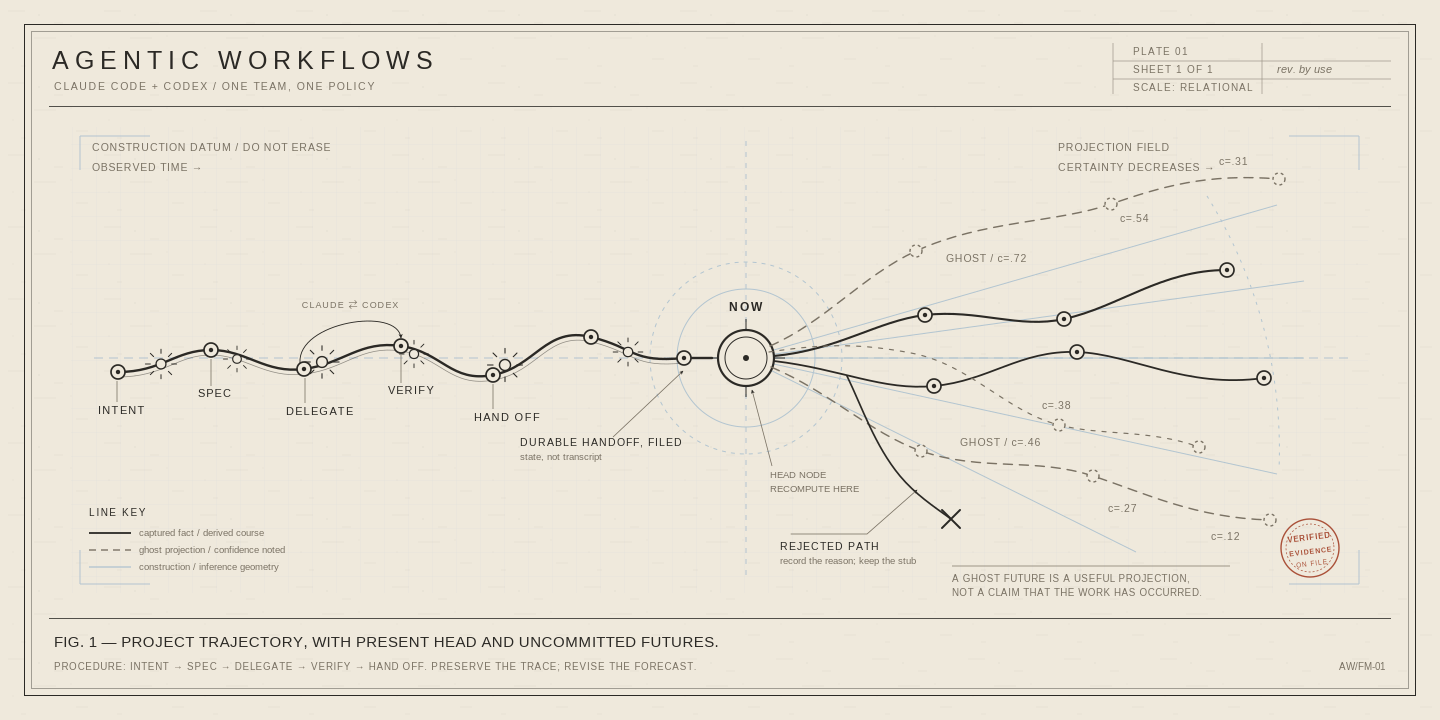
INTENT  →  SPEC  →  DELEGATE  →  VERIFY  →  HAND OFF
  ↑                                              │
└──────────────────── learn ───────────────────┘| Without a workflow | With an operating system |
|---|---|
| Every session starts cold | Project instructions, living specs, and a memory adapter restore intent |
| ”Looks good” becomes the acceptance bar | Commands, artifacts, and a second model provide proof |
| Agents collide in one giant context | A conductor assigns one bounded slice per agent, one writer per checkout |
| Decisions disappear into transcripts | Compact handoffs and typed decisions make the next action obvious |
| Push, deploy, and live writes are implied | Explicit gates fail closed before mutation |
Pick your workflow
Claude leads by default and Codex can still lead a session. Each row names both paths where they exist; fan-out across repositories goes to an Antigravity swarm.
| Need | Claude-led | Codex-led |
|---|---|---|
| Decide how to work before working | Execution-path triage (/route, /work-mode) | Same gate, $route and $work-mode |
| Delegate a bounded build | isolated-workflow (default) · cross-vendor on request: Codex from Claude, codex-workflow-hybrid · codex-workflow-lean | Claude from Codex: claude-remote |
| Fan out across repos or systems | Native swarms: an Antigravity board coordinates the workers; deep builds come back to Claude | |
| Advance several repos at once | Codex fleet: Claude conducts, one Codex session per project (archived 2026-11-21, kept as reference) | |
| Settle a consequential decision | Council review | council ($council) |
| Run a whole session | Agentic operating system | Codex-led session ($baton, /prompts:reseed, /prompts:handoff, /prompts:ship) |
| Leave work in a trustworthy state | Closeout and handoff | Same closeout, captured from Codex |
| Keep context lean | Context budget: measure with tool-stats, read through tools/, guard with mcp-result-guard | Same tools/ through the shell |
| Run the desk by voice | Voice ops: a dispatcher brain session that reads every tab and relays spoken words · bosun-brain |
Explore the visual workflow gallery →
Start small
You do not need a fleet on day one. Start with one project guide, one acceptance bar, and one clean handoff.
# via nathanmauro.io/r/agentic-workflows
git clone https://github.com/nathanmauro/agent-field-manual.git ~/agent-field-manual

# From an existing project:
cp ~/agent-field-manual/templates/AGENTS.md ./AGENTS.md
cp ~/agent-field-manual/templates/HANDOFF.md ./HANDOFF.md
Then adapt three things in AGENTS.md:
- Name the command that proves a change works.
- State which mutations need an explicit gate.
- Require a handoff when work remains.
When a second agent joins, add the shared policy, import it into Claude Code, and render it into Codex. When the project grows, add the living spec. Graduate to fleet or council workflows only when the coordination cost is real.
What is in the kit
agent-field-manual/
├── skills/       portable workflows and runnable helper scripts, with fixture tests
├── tools/        lean CLIs that replace connector reads, plus an MCP inventory
├── hooks/        Claude Code hooks, starting with the MCP result guard
├── templates/    agent guides, the shared policy, living specs, handoffs, adapters, a skill registry
├── examples/     sanitized fleet, council, continuity, and supervised-delegation artifacts
├── docs/         concepts, step-by-step workflows, diagrams, kindred systems
├── scripts/      the public-release audit (runs in CI), the codex-runner adapter, tool-stats
└── CHANGELOG.md  dated record of what changed and when the stack was last reviewed
Copyable foundations
portable-policy.md: the one operating policy every agent loads: judgment, code style, git authority, authorization across handoffs, where state lives.AGENTS.md: a compact per-project contract for scope, verification, mutation tiers, and continuity.project-spec.md: durable intent plus live round state, decisions, and deferred work.HANDOFF.md: the exact state a future session needs, including the authorization it carries.skill-registry.md: the contract a skill meets before it earns prompt surface.bosun-brain/: the project guide and voice rules for a dispatcher session that operates the desk and does no project work itself.local-adapters.example.json: clean boundaries for memory, notifications, session launchers, workers, and policy rendering.
Working patterns
isolated-workflow: the default delegated build. A fresh implementer, separate reviewers, a fix pass, and a main loop that owns git.codex-fleet: (archived 2026-11-21, reference) conductor-led, multi-project rounds with living specs, a review board, run-scoped state, and fail-closed push and merge gates.codex-workflow-hybrid: opt-in cross-vendor build. Codex implements over the supervised channel; Claude orchestrates and verifies.codex-workflow-lean: (archived 2026-11-21, reference) Codex implements and reviews; Claude is only the workflow engine and the git owner.claude-remote: a Codex-led launch of a bounded Claude session in a Herdr pane, with the authorization record.council: independent opinions, anonymized cross-review, neutral synthesis, a recorded pick. The public v0 documents the adapter contract; bring your own runner.codex-runner: the public reference adapter for the supervised channel, headless overcodex exec.
Examples you can inspect
supervised-delegation: a real turn from this repo’s own update, sanitized.fleet-round: one conductor, two fictional projects, one vertical slice each.durable-handoff: compact state that another session can responsibly resume.council-review: shared context, independent views, adversarial review, and a recorded decision.
The principles
- Treat the harness as the product. The model is one component. Instructions, tools, specs, gates, and feedback loops determine the outcome.
- Give every agent a lane. One owner, one bounded slice, one acceptance bar, one writer per checkout. Parallelism without ownership is just faster confusion.
- Replace confidence with evidence. A green command, an inspected diff, a verified user flow, or a second model’s verdict beats a persuasive summary.
- Gate irreversible actions. Commit, push, merge, deploy, message, and live-write paths are explicit and fail closed. A named workflow can carry a grant; nothing else widens one.
- Leave the system better informed. Record decisions, handoffs, and the plausible futures you can see. Never secrets, raw logs, or entire transcripts.
Read the field manual
Kindred systems
This manual is one distillation of a discipline other people have reached independently. Kindred systems maps the convergences, starting with Matt Pocock’s Skills For Real Engineers. It converged on the same discipline from the inside of a session, and since October 2026 eleven of its skills are vendored, adapted for both Claude Code and Codex, and installed on trial inside this workflow.
Where this fits
These workflows are the process layer. The implementations are separate repos:
- Black Box: the continuity and coordination service these handoff and decision patterns write to. Codex and Claude Code share one store over MCP; trajectories render the captured history beside proposed next steps.
- Agent Island: a macOS menu-bar companion for Herdr, Claude Code, and Codex Desktop that shows who is working, who needs you, and who has finished.
- Agent Observatory: cross-agent session observability and lineage.
A living, public record
These workflows are a curated export of a private control plane. The useful patterns are published; machine wiring, credentials, account routing, personal context, and raw session data are not. The private/public boundary states the rule and how the export stays current. The changelog records each pass. Model names appear only in the dated stack block above; everything else says “the configured model.”
The kit is opinionated and will keep changing when my practice does. Copy what helps. Replace the adapters. If a pattern breaks for you, open an issue with the workflow, the failure mode, and what you learned.
Conduct the work. Verify the result. Leave a trail.
By Nathan Mauro · MIT licensed · built for adaptation · last reviewed 2026-11-21